
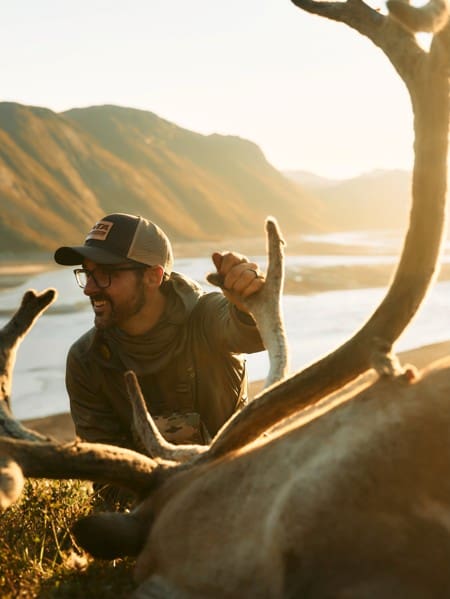
The Fair Chase co-host James Zandstra takes his TUO system to Greenland for a caribou and muskox hunt in some of the wildest country on the continent

Co-hosted by Michigan natives James Zandstra and Joe Griffen, The Fair Chase podcast and YouTube channel follow the duo from their Mitten State roots to big game adventures across North America, including hunting destinations in the Rocky Mountains, Canada, and Alaska. No question, The Fair Chase films are some of the best in the business.
Recently, Zandstra traveled to Greenland to hunt barren ground caribou and muskox. Greenland is in fact part of North America – even though it’s a couple thousand miles from the Great Lakes region where Zandstra lives. It was not Zandstra’s first caribou hunt, but he’d only encountered muskox once prior while hunting caribou in Alaska. “Caribou are awesome, and I’d hunt them every single year if I could. On that Alaska trip I had an encounter with a muskox while fishing for grayling. It was along the shore, but it was such a cool animal and I thought, I want to try for one. I found out about a Greenland outfitter that offers a combination caribou and muskox hunt,” Zandstra explains.
Planning and Logistics
Travel: Zandstra booked this trip through Worldwide Trophy Adventures (WTA). “Basically, WTA curates a group of high-end outfitters all over the world, and they found these guys in Greenland and they’ve been using them for a while. A lot of planning went into the trip, much of it travel related, booking flights…that sort of thing. We took a direct flight from Newark, New Jersey, into Nuuk on the southwest coast. WTA was very helpful in terms of preparation – getting organized, lining things up travel-wise with the fewest stops,” Zandstra explains.
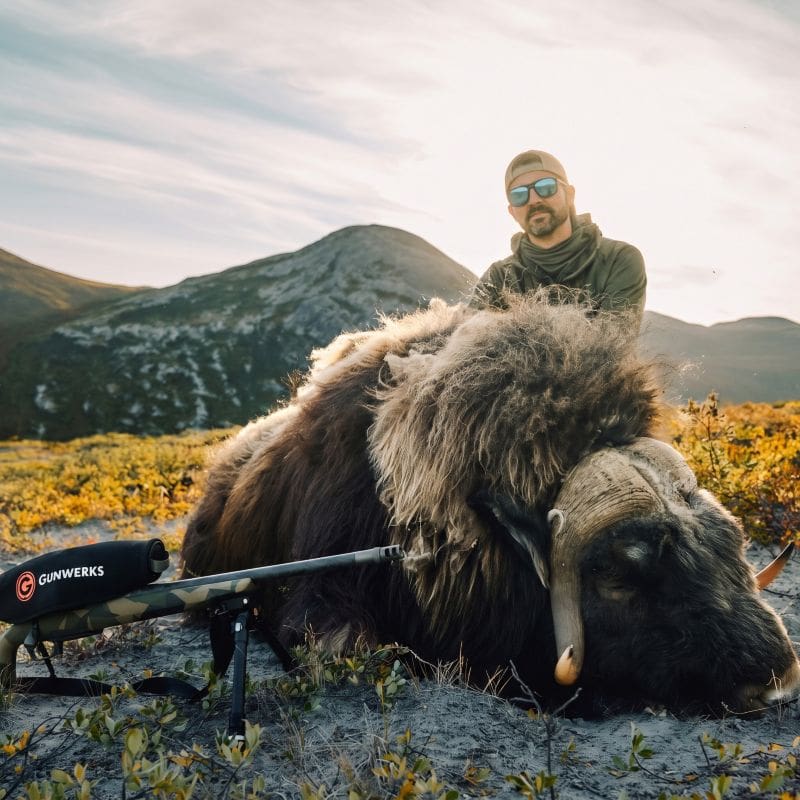
Communication: On a trip like this you choose your gear wisely. “Our guide had Starlink, so this was the first trip I didn’t bring a Garmin inReach with me, which is really a good thing to have in case of an emergency,” Zandstra says. “Another interesting piece of gear I brought with me was my rifle. I was using a .450 Bushmaster.”Firearm: The Fair Chase partnered with Gunwerks and Zandstra carried the Magnus model in .450 Bushmaster loaded with 327-grain bullets. This may seem counter-intuitive to some, but this Gunwerks rifle can send select .450 bullets downrange with some legit ballistics, and according to Zandstra, the Magnus bolt action is capable of tight groups out to 500 yards. He also attended the Gunwerks long range shooting course, but pointed out that he didn’t expect to stretch any shots in Greenland.
Clothing: “The weather can change quickly, and we were sort of boat-based much of the time. I’ve been wearing TUO gear forever and kind of have my system dialed. I wore the gaiters, the Folcrum Hoodie, and Vista Pant the entire time. Temps were usually somewhere in the 30- to 50-degree range. When we were on the water, it was quite cold, windy and wet, so I would wear something over the top like rain pants I brought along, but those other items were my core pieces, along with that Merino 200 Quarter Zip Hoodie – those three tops were money,” Zandstra explains.
“Since we could bring a tote, I also had the Amp Puffy Pants and the Kinetic Merino 350 Hoodie. We killed so many things – everybody was killing stuff – and all of our stuff smelled like blood from dressing and butchering all this game. So, at night I would pop off the pants and grid fleece and just change into the puffy and merino at base camp. Both are super soft, cozy and warm.”
Training: Zandstra regularly trains to stay in shape for hunts. Mountain hunting can be especially challenging, and it requires a level of fitness that can be an obstacle for some hunters.
“This is not a goat hunt, so I didn’t have to be in goat shape, but it’s not super easy either, so I felt prepared for it.”Outfitter: According to Zandstra, the outfitter takes care of tags and processing, and they can connect you with a taxidermist. “Everything must be sent to Denmark, and while it’s not cheap to do that, they at least make it easier by taking care of all the paperwork for you while you’re there. Our guide’s name was Hans – he owns the outfit, and he and his son Leon were our guys the whole time. They have the rights to an area, and this is a UNESCO World Heritage Site for indigenous people to hunt, which was very interesting. It’s their hunting lands.”
Planes, Boats and Walrus Meat
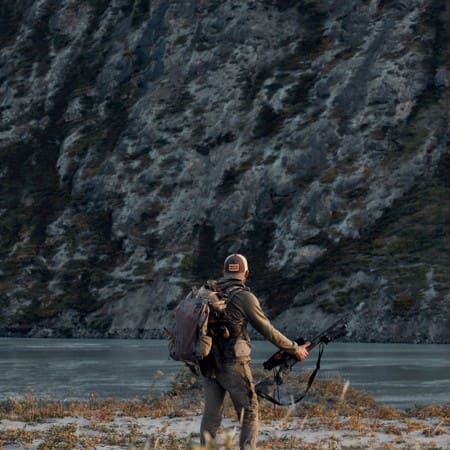
“We arrived in Nuuk, then boarded a domestic flight to Sisimiut. There are almost no roads between towns or cities, so when you travel it’s either by plane, by boat or, if it’s winter,, by snow machine,” explains Zandstra. “Eventually we took a 25-foot boat up the west side of the island and then cut into a fjord and traveled another 80 miles. After our party of hunters arrived in the fjord, we broke into groups and used smaller watercraft to travel up a glacial river.”
Zandstra describes the water as a “milky greenish,” which should be familiar to anyone who has seen glacial lakes and runoff. The trip upriver to the hunting grounds was very long, and occasionally silt sandbars required exiting the boat and dragging it across. Zandstra wore his go-to Schnee boots and TUO gaiters to stay dry in the shallow water. As Zandstra continued to describe his experience – the terrain, the people and the wildlife – the appeal of experiencing Greenland firsthand grew stronger by the minute.
“One of the other boats split off and shot a seal on the way in because they weren’t all that far away from the ocean. The entire way in we were glassing along the river looking for muskox and caribou. We picked up supplies that had been left about 40 miles upstream. It took us maybe five hours to get there, maybe more – it just took forever. Along the way we stopped at a market hunter camp and picked up more supplies. These people are market hunting as well, which was interesting. They generally target younger cow muskox because they’re just tastier. But, you go to this meat market, and like, you can find narwhal. You know, here’s the fin of a narwhal cut off, and you can buy that and all sorts of crazy stuff.”
Zandstra continued, “Technically it was day one and we came around a river bend, and I threw the glasses up and spotted muskox close to the shore. All the boats stopped and we were looking at them. I slowly panned up the slope and spotted a cow caribou, and then I looked a little higher and saw this huge bull. I’ve gotten pretty good at field judging caribou, and I felt fairly confident in my understanding of the type of caribou in this area – what to expect at first glance. I showed the guides, and they said it was the biggest one they’d seen in a long time.”
“It was early in the hunt and we were also filming, but there were other hunters in camp – two women who were hunting together, and a gentleman from New Mexico. I told them to go, I’d just hang back, you know. The women decided they wanted to shoot the muskox. The assumption was, the muskox won’t be spooked if I shoot up there, and we can maybe get a bull muskox further up, as well as the caribou,” Zandstra says. He continues, “Another issue was nobody else thought they could move fast enough and climb high enough to get close to that big caribou because he’s up a mountain. I mean, the sides of this river are just straight up like a steep mountain. So, I said alright, if nobody else is gonna do it, I can definitely make it up there. So, we ran.”
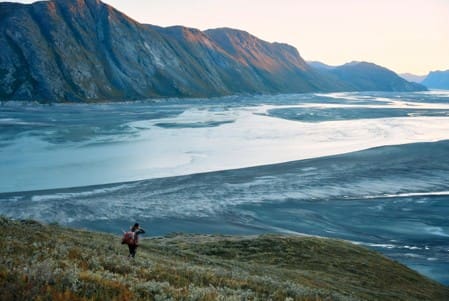
According to Zandstra, they were going up the mountain so fast at one point he got so far ahead of his camera guy he couldn’t see him. “Finally, he caught up and he was all mad about it. So, finally we get to the spot where this bull caribou was, but he wasn’t there. We kept moving at a slow crawl and suddenly I could just see the tops of his antlers popping up over this little bump in the tundra on the side of the mountain. We kept crawling a little further so I could get a shot.”
At about 85 yards, the big bull walked out and faced Zandstra with his head down. “I waited and waited, and he finally turned and I shot him quartering slightly broadside. He dropped like a ton of bricks with that .450…just crumbled. We were cutting him up and heard a shot down below. They had shot the muskox. So, we hadn’t even set up a spike camp yet, and we shot a giant caribou and a really good muskox too. We found the area was very game rich the whole week. There are very few people, and using river transport you can move large distances fast, and you know, you kind of figure out the areas.” “It was very wild. At one point I asked my guide Hans how long his family had been hunting here. He looked at me and told me his family had been hunting there for over 4,000 years. I’m thinking, okay that’s a long time, long time. You are in a game-rich environment; there are animals everywhere. It’s just crazy. It’s totally wild and virtually untouched, just a handful of people use it within a given year.
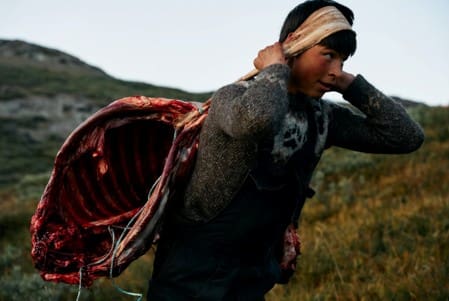
“Throughout the week, we were going up-and-down the river looking for stuff up on the mountains, and yeah, by the end of the week we had shot four caribou and four muskox – we all limited out. We spent a lot of time carrying and cutting up game. It was constant action, constant,” Zandstra says. “The first night after we killed those two bulls we were in camp, and Hans brought out this big bag the size of a 5-gallon bucket, and he had some meat in there. He started cutting chunks off this half-frozen meat and handing it out. It’s walrus. We were eating walrus raw, and also boiled, with no seasoning. These guys cut chunks half the size of a baseball and put it in boiling water. That’s how they cook it. There is no seasoning. We also ate a bunch of whale. They basically cut a triangle into the whale skin, and it’s intact so you get that fat with the skin on and eat it with caribou jerky. We ate all sorts of muskox, caribou, whale and walrus – all sorts of cool stuff.”
The fall season is when the caribou/muskox combo is possible. It generally runs from August through late October and covers pre-rut through peak rut. Temperatures and conditions are comfortable during August and September but may require strenuous mountain hiking on rocky, tundra plateaus at 1,000 feet or more of elevation. As winter sets in, game tends to hug lower altitude coastal areas with less snow and better forage availability, which also requires less strenuous tracking. Toward the end of the season, the weather can be challenging. Some outfitters also offer late-winter/spring hunts for select species.
So how difficult is it to pull off a Greenland hunting trip, and how much does it cost? It may be counterintuitive, but as big game hunting expeditions go, it’s not as spendy or difficult to get there as you may think. “It’s not too bad, honestly,” says Zandstra regarding the cost of a Greenland hunt. “It’s probably around 12 grand for the hunt. The big expense is getting the meat and the trophy home – that is expensive. At one point I just decided I didn’t care about the cost, and I’d do it again for sure.”