

TUO ambassador and whitetail hunting expert Jared Mills shares advice for bagging your buck before the clock runs out
Elite whitetail hunters will tell you tagging big bucks isn’t rocket science, but more a matter of simply adhering to steadfast strategies while adapting them to each hunt scenario, and of course, maintaining discipline throughout the season as far as wind direction and scent.
Iowa whitetail specialist Jared Mills is one such hunter, and he regularly shares his deep understanding on how big bucks function with the rest of us on Project Whitetail 365 on the TUO YouTube channel. With over thirty-four thousand followers and nearly four-million views, his habit of consistently connecting with Iowa brutes with a stick and string has no doubt inspired and zeroed-in many deer hunters.
“I live in Eastern Iowa with my wife Jacky and daughter Remi. I have been bowhunting for about 23 years,” said Mills. “I film and produce all of my hunts for others to enjoy and learn from.” Recently, TUO and Mills collaborated on the Whitetail 365 (link?) project. When the subject of late-season whitetails came up, he was happy to share some of his thoughts on what can be the most challenging period of the season…
Late season whitetails are arguably the smartest deer any hunter will deal with. Often heavily pressured, weary from hunter missteps, and perhaps a little worse for the wear, these bucks survived by a little good luck, experience, and higher intelligence. Besides the “second rut”, do you consider any other factor important to capitalize on – nutrition/food source, water, etc.? Do you hunt different – heavy cover, morning or evening?
Mills: Late season deer, especially the pressured ones, can be very skittish and hard to get close to. However, they also become a little more predictable than other times of the year based on their need to feed and find food sources when there is less available. I tend to shift my efforts to food sources or areas leading to those destination food sources. My favorite time to hunt during the late season would be an afternoon hunt, ideally on a cold, high pressure day.

Question: Late season hunts often occur during tough conditions. How do you adjust your clothing, and do you have any special “hacks” to stay warm? Heated vest, baselayers, etc.?
Mills: Late season hunting certainly requires more clothing, but as a bowhunter, I still don’t like being too bulky. So, I try to be very efficient with my baselayers, using heavier weight merino and potentially a heated vest as well. I also have a couple of “rules” if you want to call them that.
1) I do everything I can to avoid breaking a sweat on my walk in. This means packing outer layers instead of wearing them. My rule is simple – if I’m not cold when I leave the truck, I’m wearing too many clothes. 2) During my drive to my hunting property, even on the coldest days, I do not blast the heat. I don’t think it helps at all to get all nice and comfortable in a toasty warm truck, only to step outside into the stark contrast of cold temperatures.
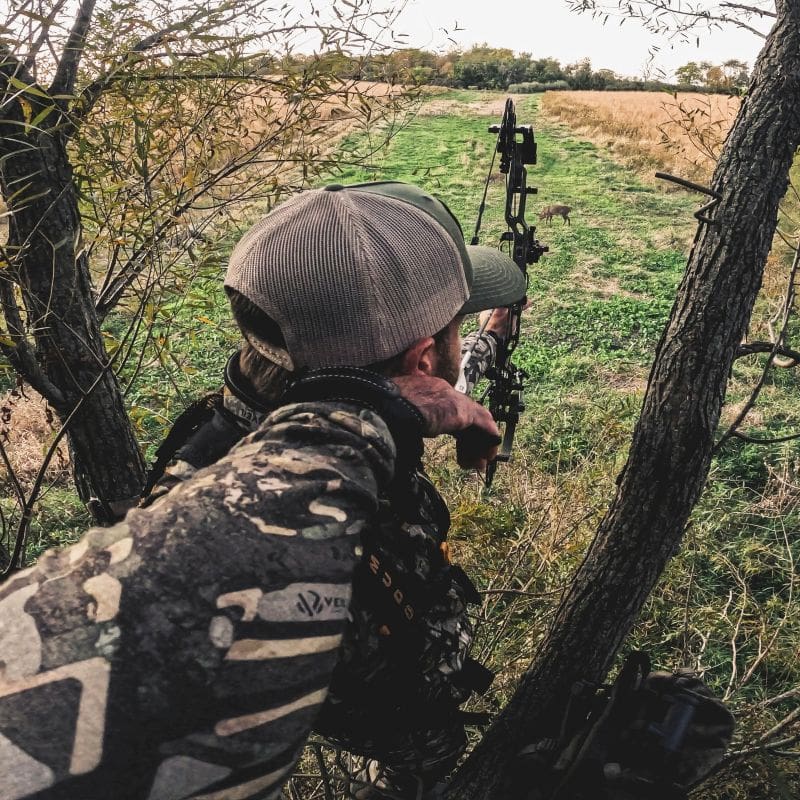
Question: Each situation may dictate how you hunt, but do you prefer to hunt from a ground blind (or hunting from the ground in general), or from a tree? With less foliage, is visual exposure something you consider?
Mills: The situation certainly dictates this, and I enjoy hunting from the ground when the cover is sufficient, however, being in a tree, especially when it comes to weary late season deer, is probably my preference. Sometimes you need to bring up your own cover such as cedar limbs for example, but being out of deer-eye-level is an advantage.
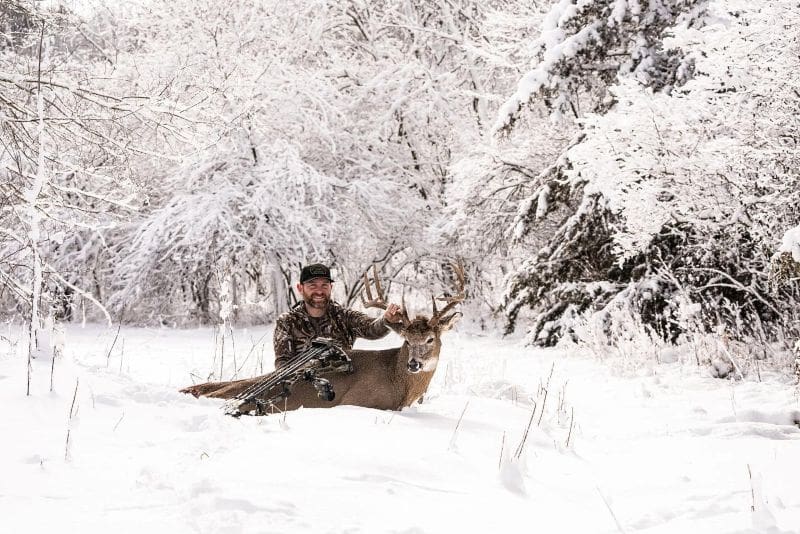
Question: Late whitetail hunting is often associated with gun seasons, but many hunters continue to use archery equipment throughout the season. Obviously, your preference is archery, but do you ever use firearms during the late season? Mills: I don’t have an issue with whatever guys want to use, and I understand the late season is different, but I’m an archery guy. I enjoy the chase and the challenge too much to switch to a gun, even during the tough late season. So, throughout the season you can find me using either my Hoyt compound or recurve trying to get close to the deer.
Question: Do you use scents and attractants during the late season? And if so, do you adjust which type of scent?
Mills: I don’t use scents as often during the late season, but I will still use them on occasion, especially if I have a scrape to help get deer into bow range. I’ll typically just use a herd scent and a preorbital and avoid the estrous scents altogether.
Question: How do you approach a typical hunt? Do you “go in” differently? Mills: As I mentioned, late season can be a tough time to hunt mostly because you can’t get away with as much compared to earlier in the season when the deer may be more forgiving, so entry and exit are certainly more critical this time of year. Getting in is obvious – you don’t want to spook the deer before the hunt even starts, but a solid exit route is just as important and sometimes overlooked. If you spook deer at the end of a hunt, your chances of that spot continuing to be productive will decrease. Ideally, you have a setup where the deer work past you and by the end of the night, you’re able to sneak out the other way. But not all spots set up like that, so sometimes I will use ditches or screens to get out, other times I just have-to wait until the cover of pitch-black darkness. I have found that deer tend to relax and be more forgiving after dark. Either way, I spend a lot of time and attention on my entry and exit being clean during late season hunts.